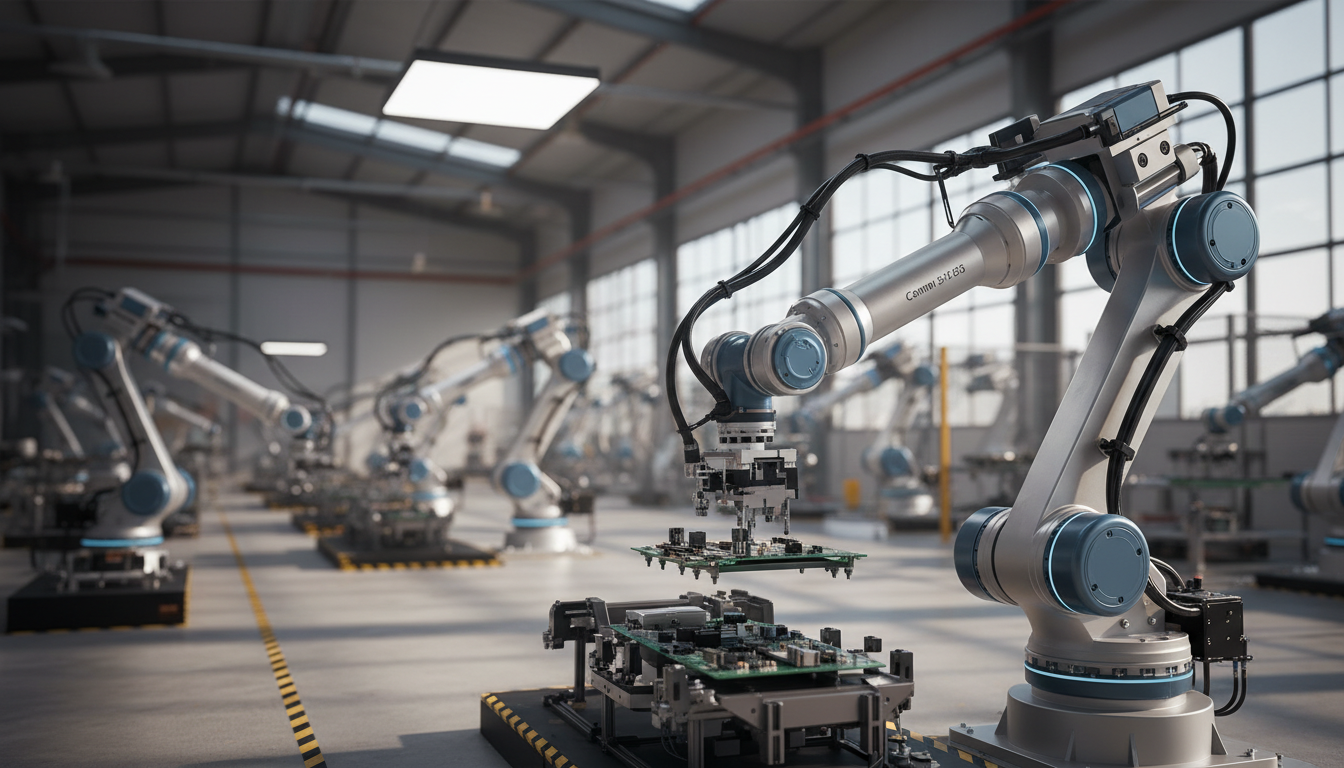
Manufacturing executives grappling with persistent workforce gaps now have another automation option to consider. Barcelona-based robotics company Theker recently closed an $85 million Series A funding round, positioning itself as a solution for factories seeking flexible automation that can adapt to varying tasks.
The funding round, led by CRV and including participation from Samsung and Bernard Arnault’s Aglaé Ventures, represents what the company describes as Europe’s largest Series A for a robotics firm. The capital injection comes less than twelve months after Theker’s seed funding milestone.
Modular Design Philosophy
Where traditional industrial robots excel at repetitive single tasks, Theker has built its platform around adaptability. The company’s machines feature interchangeable components that allow the same robotic system to handle diverse operations across warehouse and manufacturing environments.
Co-founder Carla Gómez Cano explained the design rationale, noting that real manufacturing processes rarely involve identical repetitive motions. Theker’s robots can swap hands, resize arms, or reconfigure their overall form factor depending on whether they’re sorting packages, handling textiles, or managing beverage containers.
This modular approach differs from the humanoid robot development path pursued by companies like Boston Dynamics, which focus on fixed-form robotic systems that mimic human movement patterns.
Strategic Customer Base
Fashion giant Inditex, parent company of Zara, has backed Theker as an early investor and deployment partner. The relationship signals Theker’s initial focus on retail logistics operations, though the company has broader industrial manufacturing ambitions.
Samsung’s participation as both investor and potential customer illustrates the strategic nature of Theker’s funding round. Gómez Cano confirmed advanced discussions with the Korean electronics manufacturer about a partnership that would span supplier, customer, and investor relationships.
The startup deliberately bypasses corporate innovation departments, instead targeting operational leaders who control purchasing decisions and face immediate automation needs. This direct approach aims to accelerate deployment timelines and generate revenue faster than traditional pilot program pathways.
European Expansion Strategy
Theker operates from a demonstration facility in central Barcelona and plans additional showrooms across Europe, the United States, and Asia. The company intends to expand its workforce from current staffing levels to approximately 120 employees by year end, focusing on technical development, deployment operations, and sales functions.
The hiring surge reflects broader demand, with the company reporting receipt of 15,000 job applications. Gómez Cano noted the funding round exceeded initial targets of $30 to $40 million, demonstrating investor appetite for robotics solutions that address labor market constraints.
Manufacturing Automation Trends
The robotics industry has seen increased investment as manufacturers confront ongoing workforce challenges. Traditional automation requires extensive customization for specific tasks, creating deployment delays and cost barriers for companies seeking operational flexibility.
Theker’s approach addresses these constraints by offering reconfigurable systems that can adapt to changing production requirements without complete hardware replacement. This flexibility could prove attractive to manufacturers operating multiple product lines or seasonal production cycles.
Barcelona’s emergence as a robotics development center has supported Theker’s growth trajectory. The company views its European base as advantageous rather than limiting, citing access to technical talent and favorable operating conditions.
Commercial Deployment Focus
Unlike many robotics startups that emphasize research and development phases, Theker prioritizes commercial deployment from early stages. Co-founder Jiaqiang Ye Zhu and Gómez Cano structured the company around immediate customer needs rather than extended pilot programs.
This market-first approach has guided product development decisions and customer acquisition strategies. The company targets operations managers facing immediate labor constraints rather than innovation teams exploring future automation possibilities.
The regulatory environment for industrial automation continues evolving as robotic systems become more sophisticated. Theker’s modular design allows for component updates that can address changing safety or compliance requirements without full system replacement.
Manufacturing automation represents a growing segment within institutional investment portfolios, as private equity and venture capital firms allocate capital to companies addressing labor market disruptions. Theker’s funding round reflects institutional confidence in robotics solutions that offer operational flexibility alongside cost efficiency.
The company’s expansion plans will test whether its adaptable automation approach can scale across diverse manufacturing environments while maintaining the flexibility that differentiates its offering from traditional industrial robotics platforms.